

『Egr Flow Meter Function: How It Measures Exhaust Gas Recirculation Flow』Related information(v cone flow meter|rotary gas meter|gallon meter|gear meter|metal tube rotameter|glass tube rotameter|nutating disk meter|transit time ultrasonic flow meter|wedge flow meter|pd meters|hydraulic flow meter|ultrasonic water flow meter|water flow meter|air flow meter|magnetic water flow meter|oxygen flow meter|gas flow meter|argon flow meter|air velocity meter|gasoline flow meter|fuel flow meter|ultrasonic water meter|digital water meter|nitrogen flow meter|solid flow meter|Oxygen tank flow meter|digital water flow meter|diesel fuel flow meter|steam flow meter|02 flow meter|compressed air flow meter|oil flow meter|liquid flow meter)
EGR Flow Meter Function: How It Measures Exhaust Gas Recirculation Flow
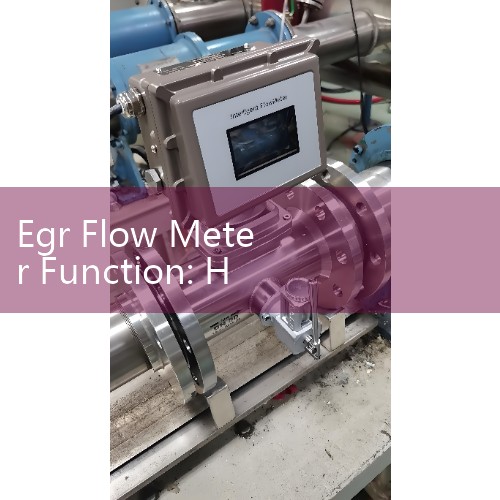
Quick Answer: An EGR flow meter measures the mass or volume of exhaust gas that is recirculated back into the intake side of an engine. The flow signal goes to the engine control unit or test bench PLC. Silver Instruments supplies industrial gas flow meters with 4-20 mA HART output for EGR lines on diesel engines, generators, and marine propulsion systems.
Engineers ask us about EGR flow meter function on test cells, field gensets, and marine engines. The question is simple. How much exhaust gas is flowing back into the intake? A meter gives a live value. That value tells you if the EGR valve position and the engine map match.
What an EGR Flow Meter Does
An EGR flow meter is placed in the recirculation pipe between the exhaust manifold and the intake air system. The meter reads flow in kg/h or standard liters per minute. It sends a signal to a PLC, ECU, or data logger. Most sites use 4-20 mA analog output. Some test benches also request HART or RS485 Modbus for remote diagnostics.
We have seen this on customer sites many times. A diesel genset manufacturer in Vietnam needed to verify EGR flow during emission tuning. They used a thermal mass flow meter on a DN40 pipe. The setup ran at 220 degrees Celsius and 1.2 bar. The meter gave direct mass flow without a separate pressure and temperature compensation. That saved them time.
How the Flow Signal Is Measured
Thermal mass flow meters are common for EGR gas measurement. They use two sensors. One sensor is heated. The other sensor reads the gas temperature. The flow of gas cools the heated sensor. The cooling rate depends on the mass velocity of the gas. The meter converts this to a mass flow value.
Differential pressure devices are also used. An orifice plate or averaging pitot tube sits in the EGR pipe. The meter measures the pressure difference across the element. A transmitter sends a signal based on differential pressure. This method works well when the gas density is stable and the pipe is straight enough.
So what is the difference in practice? Thermal mass flow meters give a direct mass reading. Differential pressure systems need density correction if pressure and temperature change. EGR gas temperature moves with engine load. A direct mass flow meter is easier to use on a dynamic engine test.
Key Parameters Engineers Check
Pipe size matters. EGR lines are often DN25 to DN80. We ask for the exact pipe inner diameter. Temperature range matters. Exhaust gas can sit between 150 degrees Celsius and 400 degrees Celsius. Pressure is usually low, from 0.5 bar to 3 bar. Flow range is often 0 to 300 kg/h on small engines and up to 2000 kg/h on large marine engines.
Output type matters too. Most control systems accept 4-20 mA. Some sites need HART protocol for configuration. Hazardous areas may require ATEX Zone 1 or Zone 2 certification. Silver Instruments offers thermal mass flow meters and vortex flow meters with these outputs and certifications for gas measurement.
For example, a customer in Australia ran a 1500 kW diesel generator test bench. They needed an EGR flow meter for a DN65 pipe at 260 degrees Celsius and 1.8 bar. Their flow range was 0 to 800 kg/h. We supplied a gas flow meter with 4-20 mA HART output and an integrated PT100 temperature sensor. The meter installed directly into the existing pipe section.
Installation Challenges on EGR Lines
EGR gas is dirty. Soot and oil mist can coat sensors. This shifts the reading over time. A good installation includes a straight run upstream of the meter. The rule is 10 pipe diameters upstream and 5 downstream for most gas flow meters. But EG
_600x400.jpg)
Condensation is another issue. When exhaust gas cools, water and acid can form. This can damage sensors that are not rated for the gas composition. We specify stainless steel wetted parts and ceramic or PTFE sensor protection on EGR applications.
Because pressure pulsation from the engine can affect the signal, the control system should apply a small damping time. A damping value of 1 to 3 seconds works for many diesel engine test cells. This gives a stable reading without hiding real flow changes.
Selecting the Right Flow Meter for EGR
Do not choose a flow meter by pipe size alone. The gas temperature, humidity, and soot level decide the sensing technology. For clean engine test cells, a thermal mass flow meter works well. For EGR lines with heavy soot, a differential pressure or vortex flow meter with purge air may be easier to maintain.
We often recommend a thermal mass flow meter when the customer needs direct mass flow over a wide turndown. Many models handle a turndown of 100 to 1. That means the same meter can read high load and idle flow. For a generator set, the EGR flow at idle may be only 10 percent of the full load value.
Tell us your pressure in bar, temperature in degrees Celsius, pipe size in DN, and flow range in kg/h. We will recommend a meter with the right sensor and output. Our team at Silver Instruments has supplied flow meters to customers in Southeast Asia, the Middle East, Africa, and Latin America. You can reach us by telephone at +86-25-68650347. WhatsApp is +86-25-52155837. WeChat is +86 15365082610.
Maintenance and Calibration on EGR Flow Meters
EGR flow meters drift when soot builds up on the sensor. Plan a cleaning interval based on engine hours. A diesel generator running 24 hours per day may need the sensor cleaned every 500 hours. Marine engines with heavy fuel oil can need checks every 200 hours.
Calibration should use air or nitrogen at the same flow range as the EGR line. Do not calibrate with cold air only if the EGR gas runs hot. Temperature compensation must be checked against a reference PT100 or thermocouple.
Recording EGR Flow Data
Many engine test benches log EGR flow, intake air flow, fuel flow, and exhaust temperature. A paperless recorder from Silver Instruments can accept 4-20 mA inputs from these meters. The recorder stores the values and shows trends. Customers in South America use this setup for emission compliance tests.
FAQ
What does an EGR flow meter measure? It measures the mass or volume flow of exhaust gas recirculated from the exhaust manifold to the intake air system. Most tests report mass flow in kg/h.
Which flow meter technology is best for EGR gas? Thermal mass flow meters are common because they give direct mass flow. Differential pressure meters and vortex flow meters are options when the gas is dirty or the pipe is large.
Can a standard air flow meter be used on EGR gas? No. Standard air flow meters often have plastic parts or low temperature limits. EGR gas is hot, dirty, and can contain corrosive compounds. The meter must have stainless steel wetted parts and the right temperature rating.
What signal output do you recommend for an EGR flow meter? 4-20 mA analog output is the most common. HART protocol helps for setup and diagnostics. Modbus RS485 is useful for remote monitoring on large engine rooms.
Do you offer explosion proof EGR flow meters? Yes. We supply models with ATEX Zone 1 or Zone 2 certification for engine test cells and offshore platforms. Tell us the gas zone classification and pipe size.
 Hot Product
 Related AD